
🇬🇧 Herschel prism
How it Works
A Herschel wedge, also called a Herschel prism, is a special filter for observing the sun. It has many advantages over a lens filter, but can only be used with refracting telescopes.
In conjunction with a telescope, a Herschel wedge provides detailed images of the sun's photosphere. Sunspots, faculae, and granulation can be observed and photographed. The Herschel wedge should not be used with reflecting telescopes, as the secondary mirror could overheat and be damaged.
At approximately 4%, the light intensity reaching the eyepiece is still too strong for visual observation of the sun to avoid eye damage. Therefore, the remaining amount must be reduced using a neutral density (ND) filter with a density of 3.0. In combination with a polarizing filter, the amount of light can be continuously adjusted. For photography, lower density neutral density filters can be used to keep the exposure time short.
(Source: https://de.wikipedia.org/wiki/Herschelkeil / License "Creative Commons Attribution-ShareAlike")
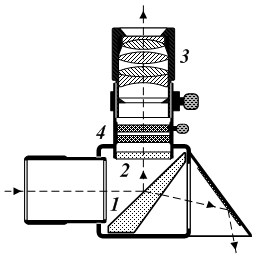
- Glass body of the Herschel wedge
- Neutral density filter
- Eyepiece
- Polarizing filter
Image Source: By Tamasflex - Own work, CC BY-SA 3.0, https://commons.wikimedia.org/w/index.php?curid=15738848
Usage Instructions
Caution is always necessary when observing the sun. Burns and injuries can happen quite easily. This is especially true with Herschel prisms, because the telescope does not carry a lens filter when using them.
Because sunlight enters the telescope unimpeded, we only recommend Herschel prisms:
- for refractor telescopes (lens telescopes)
- without internal plastic components and
- with objective lens diameters up to 150 mm.
Precautions/Safety Instructions
- Before each movement, consider whether it might concentrate too much light onto body parts or materials.
- Never leave a telescope pointing at the sun unattended.
- Before attaching or removing the Herschel prism from the telescope, swivel the telescope away from the sun.
- If you have a finder scope, attach a solar filter or its lens cap. This also applies if you have multiple telescopes or optics mounted in parallel.
- If you pause observing for an extended period, put a lens cap on the objective lens or swivel the telescope away from the sun.
- Always leave the neutral density filter attached to the Herschel prism. For visual observation, always use an additional polarizing filter or other filter with a similar attenuation effect.
- Ensure that the Herschel prism is securely clamped in the focuser. If it should happen to fall out, do not stay behind the focuser.
- Do not use flatteners, reducers, or similar devices. These could overheat.
- Check periodically whether the telescope and the Herschel wedge are unusually warm. If so, move the telescope away from the sun.
- Do not screw filters in front of the Herschel prism! Always screw color filters or similar filters into the eyepiece or camera that is connected to the Herschel prism.
When photographing through a Herschel prism, the image may appear too bright, even if the polarizing filter is set to maximum attenuation. In this case, you will need another filter between the Herschel prism and the camera.
Applications
You can use a Herschel prism very effectively with a binocular viewer. Binocular vision makes many details on the sun much clearer.
Color filters can increase contrast. Try red or green filters.
For photography, you can connect a camera directly. For focal photography, a planetary camera and the "lucky imaging" method are recommended. Digital SLR cameras can also be used, but focusing can easily fail with them, as the focuser on many refractors cannot be retracted far enough. In such cases photography using eyepiece projection is usually possible.
No comments to display
No comments to display