🇬🇧 Mounts and accessories in general
Further information
🇬🇧 Mounts in general
A mount is at least as important as the telescope optics. It should be chosen large enough to carry the telescope with low vibration.
Every mount has two axes: With altazimuth mounts, the telescope is moved in altitude and azimuth (horizontal). With equatorial mounts, however, one axis is aligned parallel to the Earth's axis. This is absolutely necessary for astrophotography with long exposure times. With a photo mount, you can use a camera with interchangeable lenses. This is ideal for travel!
The term GoTo refers to a computer control system. This makes it easier to find the desired object.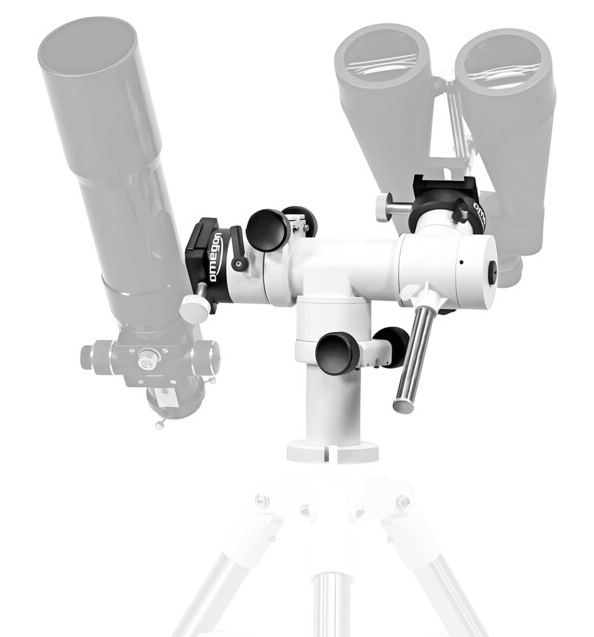 With an altazimuth mount, a telescope can be swiveled in altitude and along the horizon. This horizontal angle is also called the azimuth. Altazimuth mounts can be set up simply like a camera tripod. The advantage is that some altazimuth mounts are set up to attach two telescopes simultaneously - as in the picture here.
A particularly simple example is the Dobsonian mount. The goal was to have the largest possible telescope on a mount at a favorable price. A Newtonian telescope sits on a wooden box and can be moved freely in azimuth (horizontal) and altitude. The construction of the box is very simple: it consists of only a few parts that are assembled according to the Ikea principle. For easy movement, the telescope or the box has sliding and slewing bearings. This allows you to move the telescope into any position, often with just one finger.
Equatorial mounts are constructed in a way that one axis must be aligned parallel to the Earth's axis. This means the telescope only has to be rotated around this axis – called the hour axis – to compensate for the rotation of the sky. The selected celestial object thus remains centered in the eyepiece at all times.
To align the hour axis parallel to the Earth's axis, the north direction and the geographical latitude of the observation location must be known. If the equatorial mount has a polar finder, the Pole Star can also simply be aimed at.
A special type of the equatorial mount is the photo mount. These are very easily transportable mounts on which cameras can be placed. The photo mounts thus enable the compensation of the sky's rotation, which is necessary for long-exposure shots. They are essentially very small, equatorial mounts for astrophotographic use. The larger models of the photo mount also allow the use of heavy camera lenses or small telescopes.
🇬🇧 Tripods and Piers in General
The tripod is unfortunately an often underestimated component of the telescope system. Because if the tripod does not promise the necessary stability, it will be noticeable during observation. By choosing a high-quality tripod, the performance of the telescope and the enjoyment of observing can be significantly improved.
Piers for astronomical telescopes ensure a very stable stand. They are suitable for mounts that are permanently set up in the home garden, on the balcony, or in an own observatory. This allows the telescope to remain permanently set up and the polar alignment to be carried out very precisely. Piers are either designed to be permanently screwed to the ground or have their own feet. The transition to the classic tripod is fluid.
Pier extensions are not independent tripods. They are also called "half-piers" and merely serve to raise the mount higher. This may be necessary to prevent the telescope from hitting the tripod legs or to allow a more comfortable height for viewing through the telescope. In some cases, pier extensions can also be attached to stable tripods.
Further information can be found here in the Astroshop magazine.
🇬🇧 Connection between Mount and Tripod or Pier
The connections between telescope tripods and mounts have simply evolved over time. There are no fixed standards, but at least quite similar dimensions are used across different brands for similarly constructed mounts.
GP- / EQ5 Connection
This connection originates from the Vixen Great Polaris mount and was adopted by Skywatcher for their EQ5 mount. Similarly sized mounts from many other brands also use this design. However, the dimensions can be slightly different between manufacturers, and even between different batches from the same manufacturer. Therefore, it is difficult to state universally valid dimensions. A good overview can be found here (English).
The connection mostly fits these mounts:
Omegon
- Twinmaster,
- EQ-500 X,
- Half-pier for Kolossus,
Skywatcher
- EQ-3,
- (H)EQ-5,
- AZ/EQ-5,
- Skytee,
Bresser and Explore Scientific EXOS-2,
Celestron AVX,
Meade LX85,
Vixen GP / GP-DX.
Current Vixen mounts have a different connection than GP, see below!
EQ6 Connection
With the EQ6 mount, Skywatcher retained the shape but slightly changed the dimensions so that the connection between the tripod and the mount is also suitable for higher load capacities. The EQ6 connection mostly fits:
- Skywatcher (AZ-)EQ-6(R),
- Celestron CGEM.
3/8" Photo Thread Connection
Especially lighter mounts can have a central 3/8"-16 UNC thread. It has a 9.5mm diameter - please do not confuse it with the M10 thread: the pitch of the threads is different. If you screw a photo screw into an M10 thread, you can easily damage both!
Light photo tripods are not suitable for telescope mounts!
For a photo tripod to be used as a telescope tripod, it must:
- Be designed for significantly more load capacity than is mounted on it. This is because a telescope has much more leverage than a camera and needs to be aligned more precisely.
- Have enough contact surface area - we recommend at least 8cm in diameter.
Modern "strainwave" mounts often have a 3/8" thread. However, they are almost always meant to be connected to their dedicated tripods with other screws or clamps. Therefore, always check the connections very carefully when combining devices. Above all, the mount must be secured against rotating loosely on the tripod. This can easily happen if the telescope is turned by hand or you accidentally bump into it.
Manufacturer- and Device-Specific Connections
Particularly high-capacity mounts are almost always equipped with proprietary tripod connections. However, there are adapters for the more common mounts and tripods.
Tripods and mounts of the same brand do not necessarily have to fit together! The reason is that mounts for heavier loads require a much more stable connection - which would be oversized for a small mount.