🇬🇧 Omegon Pro Powerbanks
For the series Pro Powerbank
- Parts / Teile / Pièces / Partes / Parti / Onderdelen
- 🇬🇧 Usage notes
- Technical specification / Technische Spezifikation / Spécifications techniques / Especificaciones técnicas / Specifiche tecniche / Technische specificatie
- 🇬🇧 Handling and safety
- Copyright
Parts / Teile / Pièces / Partes / Parti / Onderdelen
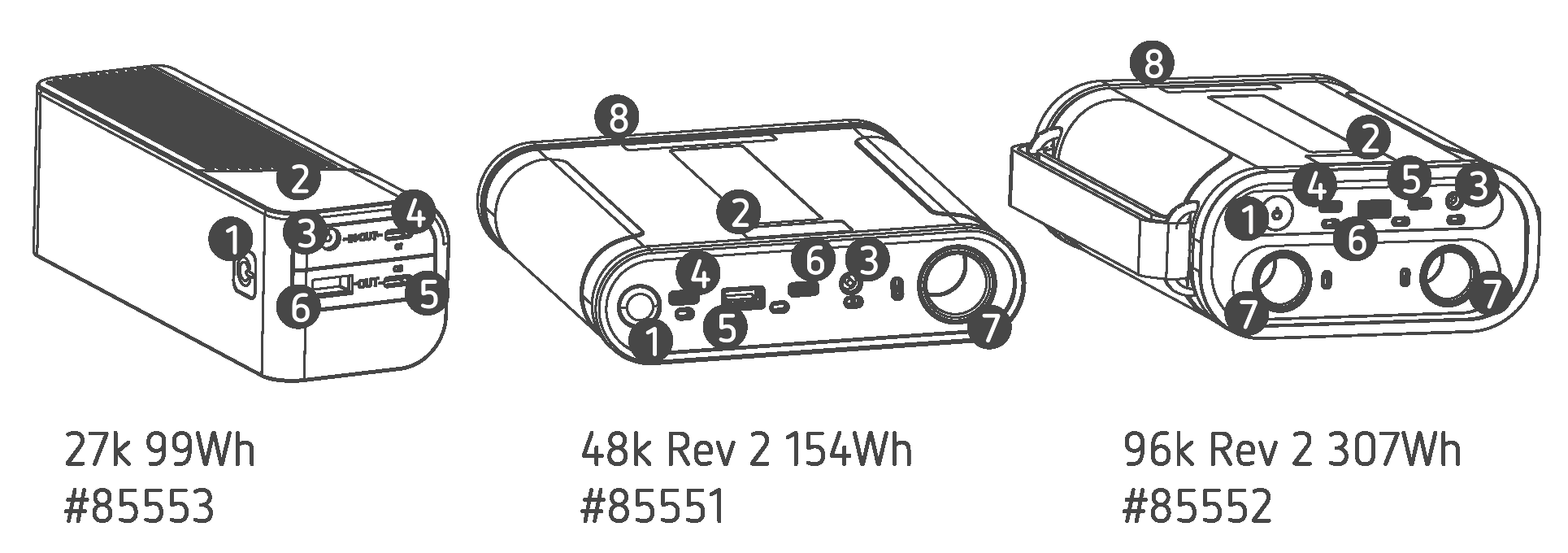
1 | Button | Taste | Bouton | Botón | Pulsante | Knop |
2 | LED Display | LED-Anzeige | Écran LED | Pantalla LED | Schermo LED | LED-display |
3 | DC input & output | DC-Eingang und -Ausgang | Entrée et sortie CC | Entrada y salida de CC | Ingresso e uscita CC | DC-ingang en -uitgang |
4 | USB-C1 input and output | USB-C1-Ein- und -Ausgang | Entrée et sortie USB-C1 | Entrada y salida USB-C1 | Ingresso e uscita USB-C1 | USB-C1-ingang en -uitgang |
5 | USB-C2 output | USB-C2-Ausgang | Sortie USB-C2 | Salida USB-C2 | Uscita USB-C2 | USB-C2-uitgang |
6 | USB-A output | USB-A-Ausgang | Sortie USB-A | Salida USB-A | Uscita USB-A | USB-A-uitgang |
7 | 12V Cigar lighter socket output | 12V Zigarettenanzünderbuchse | Sortie prise allume-cigare 12 V | Salida de toma de encendedor de cigarrillos de 12 V | Uscita presa accendisigari 12V | 12V sigarettenaansteker aansluiting uitgang |
8 | LED light | LED-Licht | Lumière LED | Luz LED | luce LED | LED-lamp |
🇬🇧 Usage notes
Recharging
Select either the DC port or the USB-C port for charging the power bank, not both at the same time! For the maximum charging power, see the specifications below. We recommend to charge with approximately 40 W. Charging the battery cells with less power helps to conserve them.
Solar charging
The 154 Wh and 307 Wh models also support charging by solar panels. If the panel has a voltage between 12 - 24 V, it can be directly connected to the DC port. The battery management system has a built-in Maximum Power Point Tracking (MPPT) charge controller. Feel free to use the provided barrel connector adapters.
Polarity: Center = positive!
To charge the 99 Wh power bank with solar energy, you need either a solar panel with USB output or a charge controller with proper DC output.
LED Display
It shows the charging state, the battery capacity and the selected DC port voltage
DC port output
By pressing it shortly, toggle through different available voltages:
99 Wh power bank | 154 + 307 Wh power banks |
|
|
Finally, connect your device with the proper cable.
USB outputs
USB ports can be used simultaneously. Only the USB-C1 port has a separated power control. Using USB-C2 and USB-A together will stop fast charging output.
Combinations
It is possible to use the ports simultaneously. For example one can recharge the power bank via the DC port and attach a USB device to the USB-A port at the same time. However, there are a few exceptions:
🚫 No combined usage of ports is possible in this cases:
- 99 Wh - DC + USB-C1: no combination is possible (neither charging nor recharging nor mixed)
- 154 + 307 Wh - DC + USB-C1: no simultaneous charging is possible (use only one input at a time for charging)
Automatic power-off
Some ports will be switched off after a short time to save battery, if too low power is demanded.
99 Wh | 154 Wh | 307 Wh | |
DC / USB-C1 | < 1.8 W = 150mA @12V after 5 minutes | < 1.5 W = 125mA @12V after 5 minutes | no power-off |
USB-C2 / USB-A | <0.5 W = 100mA @5V after 1 minute | <0.15 W = 30mA @5V after 1 minute | |
To prevent the power-off function, plug in another device in parallel - for example, charge your smartphone via USB-C2 if you want to keep the USB-A port active.
LED torch
To switch the light off and on for 154 Wh + 307 Wh power banks: Press the button twice.
Technical specification / Technische Spezifikation / Spécifications techniques / Especificaciones técnicas / Specifiche tecniche / Technische specificatie
🇬🇧 Handling and safety
DANGER! Lithium-ion cells can get hot or ignite and cause serious injury when exposed to extreme conditions.
Do not connect the positive and negative poles of the battery with metal objects (e.g. wire).
Only use approved LiFePO-4 chargers
Be especially careful while wearing necklaces, rings, bracelets, hairpins, or other metal objects.
Do not puncture, hit, or step on the battery.
Do not immerse the battery in liquid and avoid moisture.
Do not use a LiFePO4 battery with other types of batteries.
Do not connect the battery to an alternator or non-electronically controlled charging system (except when using a voltage regulator).
Do not smoke next to the battery.
Be careful not to let heavy objects fall on the battery.
Keep it away from children.
Do not store it in or in the near fire, on stoves or on other Places with high temperatures.
Do not expose it to direct sunlight or use/store the battery in cars in hot weather. Otherwise, the battery may release heat or ignite. This use may also result in loss of performance and shortened lifespan.
Do not disassemble or modify the battery. The battery is equipped with safety and protection devices that, if damaged, could cause the battery to become hot, explode or ignite.
Stop using the battery immediately if it emits an unusual odor, becomes hot, changes color or shape, or otherwise appears unusual during use, charging, or storage.
Do not insert the battery intoMicrowave oven, a high pressure container or on induction hotplates.
Check it regularly for damage, cracks and corrosion on the connections. Do not use it if you notice any damage.
The terminals can always be live, so do not place metal objects on a Li-ion battery.
Avoid short circuits, deep discharges and high charging currents.
Use tools with insulated handles.
When working with the battery, avoid wearing any metal objects, e.g. watches, bracelets, rings, etc.
If the battery burns, you must use a Type D foam or CO2 fire extinguisher to extinguish it.
Do not open or disassemble the battery. Electrolyte is highly corrosive. Under normal conditions contact with it is impossible. If the case is damaged, do not touch exposed electrolyte or powder as it is corrosive.
Li-ion batteries can become projectiles in an accident due to their large mass. Always ensure secure attachment
Transport it carefully as Li-ion batteries are sensitive to mechanical shock.
Before use, check whether the battery emits noises that indicate a defect. Do not use the battery if it crackles, hisses or anything similarSounds can be heard – there is a risk of fire.
Use good quality and correct size cables.Battery cables must be crimped, preferably soldered. Solder connections alone are not sufficient. UL listed battery cables are recommended.
General safety instructions
Please keep this guide safe so you can refer to it. Pass it on to subsequent owners.
This device is not intended to be used by persons (including children) with reduced physical, sensory or mental capabilities or who lack experience and/or knowledge, unless they are supervised or given instructions by a person responsible for their safety, how to use the device.
The device is not a toy for children. Therefore, keep children away from it. Children must be supervised so that they do not play with the battery.
Converting or changing the device impairs product safety. Changes and repairs to the device may only be carried out by the manufacturer or by persons expressly authorized by the manufacturer. Never open the device yourself. Don't do any repairs yourself!
Handle the device carefully. It can be damaged by shocks, blows or falls from even a small height.
Keep the device away from moisture and extreme heat.
Stay nearby while charging the battery and check its temperature regularly. If the heat is high, stop charging immediately. A battery that heats up or deforms during charging must not be used.
Never immerse the device in water or other liquids. Do not touch the device with wet or damp hands.
Check the device for damage before using it for the first time. Do not use it if there is visible damage.
Never use the device after a malfunction, e.g. if it has been dropped into water, dropped or otherwise damaged.
Disconnect the battery from connected devices if you will not be using it for a long period of time.
Disposal instructions for batteries
Batteries must not be disposed of in household waste. As a consumer, you are legally obliged to return defective batteries that can no longer be charged for proper disposal. You can hand in your batteries at public collection points in your community and wherever batteries of the same type are sold.
Electrical devices contain valuable resources, but also pollutants. The collection points give them to certified waste disposal companies who check whether the devices can be reused. Ideally, old devices can be refurbished. If not, pollutants are removed from the devices and valuable resources are recycled if necessary. This protects the environment.
Note on waste avoidance
According to Directive 2008/98/EC on waste and the legislation of the Member States of the European Union, waste prevention measures generally have priority over waste management measures. In order to avoid waste, the main aim of electrical and electronic devices is to extend their service life by repairing defective devices and selling functional used devices instead of disposing of them. The federal waste prevention program contains further information.
Copyright
🇬🇧 Reproduction of the contents of this document in whole or in part outside of private use is expressly prohibited in any form. Changes and errors excepted. All texts, images and characters are the property of NIMAX GmbH.
🇩🇪 Die vollständige oder teilweise Vervielfältigung der Inhalte dieses Dokuments außerhalb des privaten Gebrauchs ist in jeder Form ausdrücklich verboten. Änderungen und Irrtümer vorbehalten. Alle Texte, Bilder und Zeichen sind Eigentum der NIMAX GmbH.
🇫🇷 La reproduction, intégrale ou partielle, du contenu de ce document à des fins autres que privées est formellement interdite. Sous réserve de modifications et d'erreurs. Tous les textes, images et marques déposées sont la propriété de NIMAX GmbH.
NIMAX GmbH
Otto-Lilienthal-Str. 9
86899 Landsberg am Lech
Geschäftsführer / directors / Directeurs: Dominik Schwarz, Ben Schwarz, Patrick Bosch
Handelsregistereintrag / N° Registre du commerce: HRB 21932 - Amtsgericht Augsburg
Ust.-Id. / N° d'identification TVA: DE250000378
ElektroG Reg.Nr.: DE 95429205
Batt-Reg.-Nr.: DE 94266517
WEEE Nr.: 95429205
Verantwortlich gemäß § 18 Abs. 2 MStV / Directeur de la publication: Ben Schwarz, NIMAX GmbH, Adresse wie oben.